
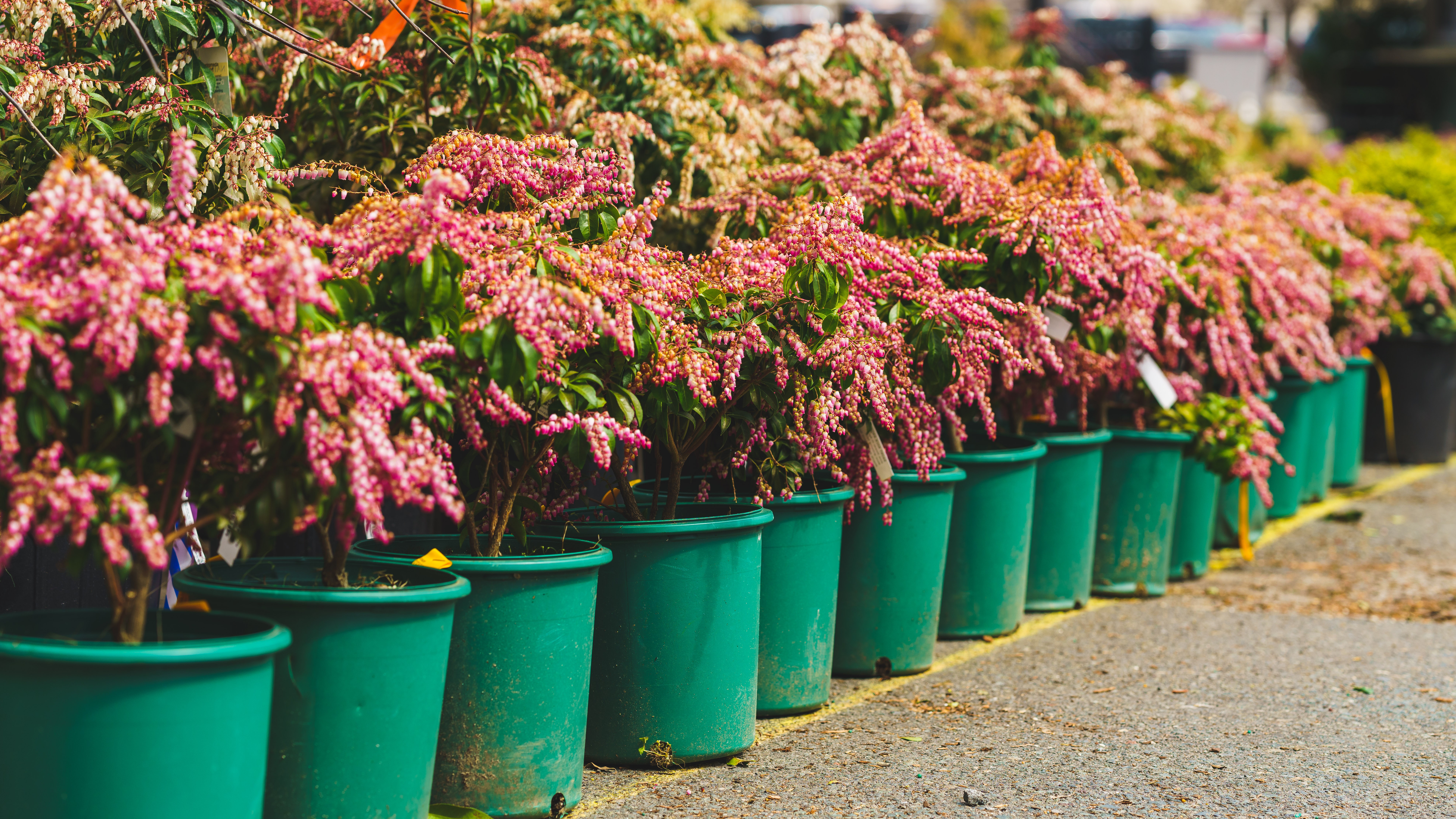
All About Andromeda
One of the earliest shrubs to bloom in the spring, Andromeda offers an elegant flower form that merits close inspection. Individual flowers may remind you of lily of the valley, but rather than one individual flower, they are grouped in large clusters that hang down from the tiered branches, each cluster up to 6” long. Often fragrant, they shimmer in the early spring landscape. Flowers may be white, pink or deep rose, depending on the variety.
Native to the mountain regions of the Far East, Pieris japonica is wonderfully hardy in our area. It is a shrub with four seasons of interest. Glossy dark green leaves remain evergreen all year and for that reason alone, it merits inclusion in our gardens. But there is an added foliar element – new leaves emerge as the flowering cycle is coming to an end and are bronze to red in color. The contrast is eye-catching. As the colorful new leaves turn dark green, buds for next year’s flowers are forming. The buds are bead-like and showy, rather like having jewelry on your shrub! The buds’ summer show continues throughout the winter, adding interest and contrast to the evergreen foliage.
Landscaping Andromeda
Andromeda are excellent companions for Rhododendrons and Azaleas as they grow in similar conditions. They are ideal for use in foundation plantings, woodland edges and mixed borders. We are perhaps most familiar with the 3’-5’ tall, mid-sized varieties but there are excellent low growing varieties for the front of the border, and even dwarf varieties under 2’ tall which can be grown in containers. Versatile, they will grow in light conditions ranging from sun to partial shade to full shade. If grown in full sun, they will be happiest with some afternoon shade. And no matter the light conditions, they do appreciate protection from the drying effects of winter winds and sun. They like the acidic nature of our New England soils, and to look their best, they prefer that soil to be rich in organic matter.
Deer resistant, they are also a favorite and important food source for our native pollinator, the mason bee. Here are varieties to consider for your landscape.
Our Favorite Andromeda Varieties
 Pieris japonica ‘Compacta’
As the name suggests, this variety is somewhat smaller than traditional varieties of Andromeda. It grows to a height of 4’. As well, the leaves are slightly smaller than traditional varieties. It flowers heavily with trusses of white, bell-like flowers that are lightly fragrant. After the flowers fade, new foliage emerges and is flushed with red-bronze tones. As this new foliage matures it becomes a lovely shiny, deep green.
 Pieris japonica ‘Dorothy Wycoff’
‘Dorothy Wycoff’ is a beautiful variety, admired for its year round interest. It features dark red winter flower buds which open to reveal white flowers with a soft pink tone. The foliage is glossy and dark green in summer, turning mahogany-red in winter. This shrub will reach a height of 5’ in 10 years.
 Pieris japonica ‘Katsura’
‘Katsura’ is a lovely plant with arching trusses of rich rose- pink, bell-shaped flowers that appear in early spring. A distinguishing feature of this variety is that new foliage emerges not just in spring, but into summer, offering a particularly long season to enjoy the dramatic, glossy, wine-red color of new growth. In 10 years, ‘Katsura’ will reach a height of 5’ and a similar width.
 Pieris japonica ‘Little Heath’
‘Little Heath’, as the name suggests, is smaller than many Andromedas, growing 2’-3’ high and wide at maturity. Pendulous white bell-shaped flowers appear in early spring. Unusual for Andromeda, ‘Little Heath’ has variegated foliage – each leaf is outlined in cream. New foliage emerges with bronze- red colored tones. It performs well in the ground and is also suitable for container planting.
 Pieris japonica ‘Mountain Fire’
‘Mountain Fire’ is a showy and dramatic Andromeda, noted for its spectacular brilliant red new growth which remains on display for several weeks. No muted bronze tones for this variety. ‘Mountain Fire’ has lovely clusters of fragrant white flowers. It will grow slowly to a height of 6’ and a similar width.
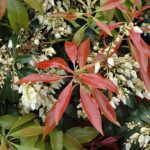 Pieris japonica ‘Scarlet O’Hara’
Another Andromeda with lovely bronze-red new growth, ‘Scarlet O’Hara’ is notable for its relatively early and profuse bloom. Clusters of pink buds open to fragrant white flowers. Leaves mature to glossy dark green on lovely red stems. More narrow than many Andromeda, ‘Scarlett O’Hara’ will grow to a height of 6’-8’ and a width of 4’-6’ in 10 years.
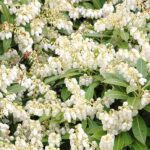 Pieris japonica var. yakushimanum ‘Cavatine’
This hardy, slow growing Andromeda is increasingly popular. It has small leaves and grows as a dense, compact mound only 2’ tall and a bit wider in 10 years. Trusses of white flowers open slightly later in spring than other varieties and are particularly fragrant and long lasting. This variety is well suited to the smaller garden. It can be used in a foundation planting or mixed border, and is particularly attractive when used to line a walkway.
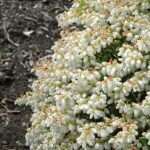 Pieris japonica var. yakushimanum ‘Prelude’
‘Prelude’ is similar to ‘Cavatine’ with the same low, mounding shape. Flower buds are pink, opening to long lasting, delicate white blooms. Emerging foliage has a pinkish tint before maturing to rich dark green.
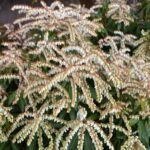 Pieris x ‘Brouwer’s Beauty’
Developed in Connecticut, ‘Brouwer’s Beauty’ is a cross between Pieris japonica and our native Pieris floribunda. The result is a beautiful shrub with purple-red winter buds which open to an abundant display of slightly fragrant white, bell-shaped flowers that are upright and slightly arching. New spring foliage is yellow-green, maturing to shiny dark green in summer and bronze in winter. The rich winter foliage complements the deep red flower buds, creating winter interest in the garden. Very hardy, it is slow growing, forming a dense shrub 5’-6’ tall and 3’-4’ wide in 10 years. This variety was a Cary Award winter in 2000, signifying its outstanding garden performance in our region.
Andromeda Flowers FAQs
What are Andromeda flowers?
Andromeda flowers are clusters of small, bell-shaped blooms that grow on evergreen shrubs in the Pieris genus. They are known for their delicate white or pink flowers and glossy green leaves.
When do Andromeda flowers bloom?
Most Andromeda flowers bloom in early to mid-spring. The blooming period can last several weeks, depending on the variety and growing conditions.
Where do Andromeda flowers grow best?
Andromeda flowers thrive in partial shade and well-draining, acidic soil. They prefer cool to moderate climates and are often grown in woodland gardens or shaded borders.
How do you care for Andromeda flowers?
To care for Andromeda flowers, water regularly to keep the soil moist but not soggy, prune lightly after blooming to shape the plant, and apply acidic fertilizer in early spring.
Are Andromeda flowers toxic?
Yes. All parts of the Andromeda plant contain grayanotoxins, which are toxic to humans and animals if ingested. Avoid planting them where pets or livestock may graze.