
November 26, 2025
Bringing the Christmas Rose Indoors: Beauty, Meaning, and Care
Outside, winter may be bare — but indoors, the Christmas Rose, Helleborus niger, blooms with life, offering elegant color and calm to holiday spaces.
Helleborus are cold-season bloomers with elegant white flowers that often open right around the holidays. In Europe, it’s long been treasured as a symbol of protection, grace, and hope in dark months. More recently, it’s become a favorite here in New England as a living alternative to traditional cut flowers — something you can enjoy in your home in December, and then plant outdoors for years of blooms to come.
Let’s talk about why the Christmas Rose is special, how to display it indoors for the holidays, how to take care of it, and some of the beautiful stories and legends attached to it.
What is a “Christmas Rose,” anyway?
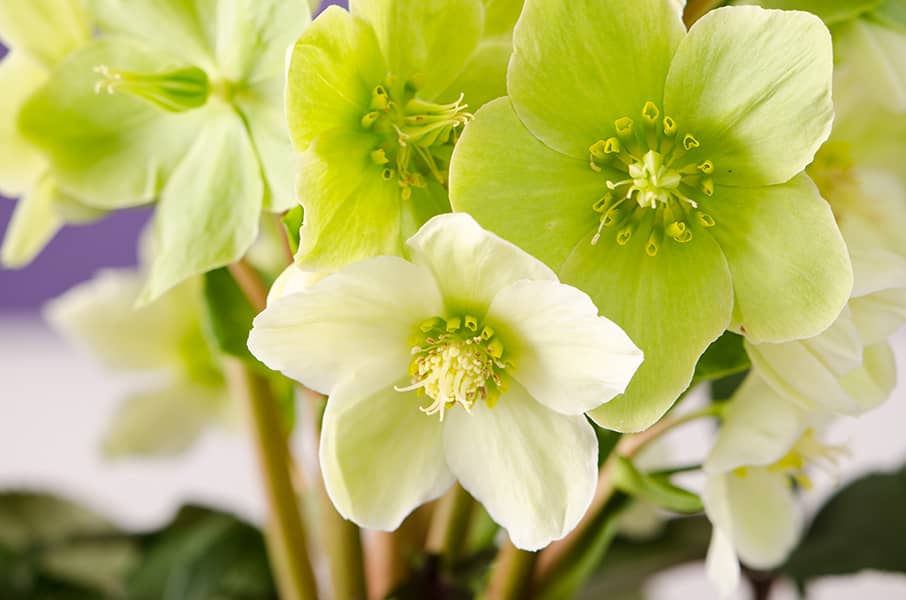
Despite the name, the Christmas Rose isn’t actually a rose at all. It’s a hellebore — specifically Helleborus niger — a hardy perennial from the buttercup family. It naturally blooms in winter to very early spring, even pushing up flowers through frost and snow.
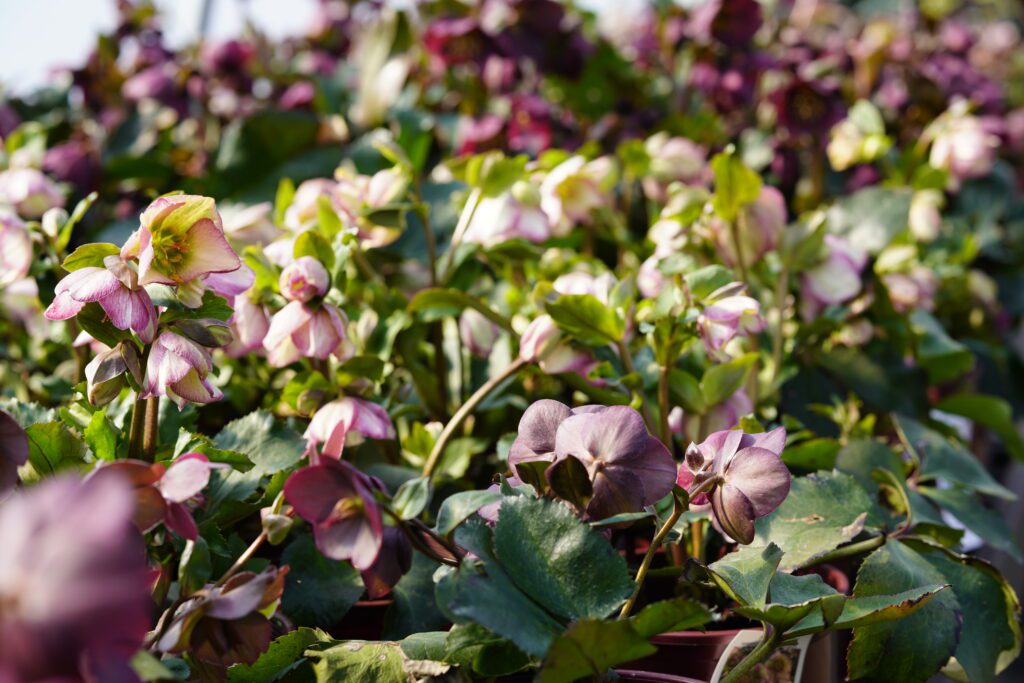
The flowers are usually a soft winter white, sometimes blushed with pale pink or touched with green as they age. The foliage is deep, glossy, evergreen, and handsome on its own. Indoors, that contrast — dark leaves, bright flowers — looks clean, calm, and seasonal without being flashy.
Today you’ll also see other hellebores (like Helleborus × ericsmithii, often sold as “Snow Rose,” and Helleborus orientalis, called “Lenten Rose”) offered for holiday decorating. These cousins come in creams, blush, burgundy, even speckled plum, and they mix beautifully with winter greens. But Helleborus niger is the classic “Christmas Rose,” and it’s the one most strongly tied to the legends.
The lore of the Christmas Rose
 Part of what makes Helleborus niger so beloved is that people have been telling stories about it for centuries.
There’s a well-known European legend that ties the Christmas Rose to the Nativity. The story goes like this: on the night of Christ’s birth, a young girl wanted to bring a gift to the manger but had nothing to offer. She began to cry, and where her tears fell in the snow, white flowers sprang up — the first Christmas Roses. She gathered them and brought them as her gift. In this telling, the plant symbolizes humble devotion, the idea that love matters more than wealth.
But that’s just one story.
In Scandinavian tradition, the Christmas Rose is also woven into a tale about grace, judgment, and transformation. Selma Lagerlöf, a Swedish Nobel Prize–winning author, retold a legend about a “holy garden” that appears deep in the forest every Christmas Eve. In her version, this miracle isn’t revealed to the respectable villagers celebrating by the fire. It’s revealed to the outcasts — a family living in poverty at the edge of society. A kind-hearted abbot is allowed to witness this secret blooming, a moment when winter turns briefly to spring: trees leaf out, fruit appears, flowers open in radiant light. He tries to bring proof back to the church so that the family can be forgiven and welcomed home.
 That proof? The roots of the Christmas Rose.
In Lagerlöf’s telling, the Christmas Rose becomes more than a pretty flower. It represents compassion for the poor, the possibility of redemption, and the belief that holiness doesn’t just belong to the powerful. It can show up in unexpected places, in rough hands, in cold seasons. That message resonates far beyond one culture.
Across many winter traditions — Christian and otherwise — midwinter flowers stand for protection and renewal. Evergreen boughs, holly, and hellebore were all brought into homes in parts of Europe as living symbols to “keep life going” through the dark months. Plants that stayed green or dared to bloom in the cold were thought to carry a kind of blessing: strength against hardship, safe passage through winter, and the promise that light would return.
Using Christmas Roses indoors for holiday decorating
• Centerpiece moment
Set a potted Christmas Rose in a low cachepot or decorative bowl and tuck in bits of moss, cones, or clipped evergreens. It gives you that “winter woodland” look without needing a full arrangement.
• Minimal and modern
Hellebores look gorgeous all by themselves. Place a single potted plant on a side table, mantle, or entry console and let the clean white blooms do the talking. This works especially well in neutral or Scandinavian-style holiday décor.
• Grouped at the table
For a long holiday table, line up several smaller pots of Christmas Roses down the runner, then scatter unscented votives between them. (Unscented is key — strong candle scents can stress the plant.)
• Floating flowers
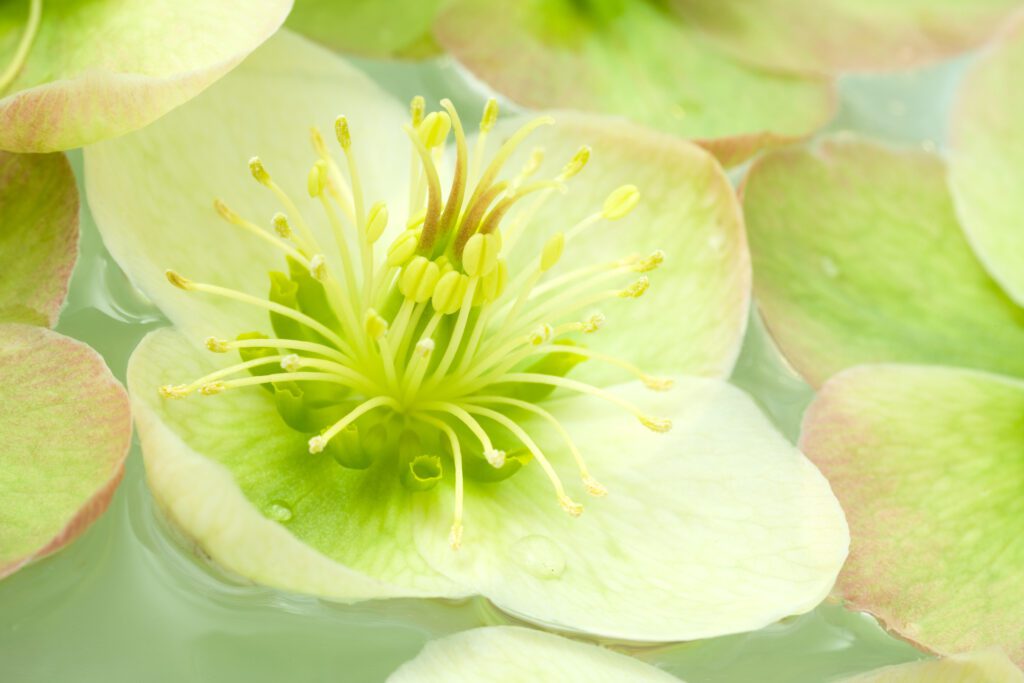
Here’s an old florist trick: gently snip a few blooms with short stems and float them face-up in a shallow bowl of water. They sit on the surface like water lilies. You can add floating candles for a soft, romantic glow.
• Mixed winter greens
Christmas Roses pair beautifully with cut greens, ivy, and even ranunculus. A grouping of hellebores, trailing ivy, and a few fir cones instantly reads “holiday” without leaning too red-and-green.
One note: hellebores prefer it cool. So if you’re hosting a big dinner and the house gets toasty, move them back to a cooler spot overnight so they can recover.
Indoor care: keeping your Christmas Rose happy through the holidays
Hellebores are outdoor perennials at heart. You’re essentially inviting a hardy winter plant to spend a few weeks inside. With a little attention, it will stay beautiful through the season — and then you can transition it outdoors.
Light
Bright light is best. Place the plant near a sunny window where it gets good indirect light or gentle morning sun. Skip hot, direct afternoon sun through glass, which can scorch leaves.
Temperature
Cooler is better. Aim for 60–65°F during the day and a little cooler at night. They don’t love being next to a blasting heat vent, wood stove, or fireplace. A bright, cool entryway, sunroom, or unheated spare room with good light is perfect.
Water
Keep the soil lightly moist but never soggy. Water thoroughly, then let the top inch of soil dry slightly before watering again. Don’t let the plant sit in standing water in a saucer.
Humidity
Average household humidity is fine for the short term. If the air is extremely dry from heating, a light mist around (not directly on) the flowers, or a humidity tray (pebbles + water under the pot) can help prevent edge crisping.
Feeding
You don’t need to fertilize while you’re enjoying it indoors in winter.
After the holidays: what to do next
This is where hellebores outshine traditional gift plants. When poinsettias and paperwhites are fading, your Christmas Rose still has a future.
Here’s how to transition it:
- After the holidays, move the plant to a bright but chilly spot — think enclosed porch, bright garage window, bulkhead, or unheated mudroom. The goal is cold but not frozen.
- Once the ground is workable in late winter or early spring (for us in Massachusetts, that’s typically late March into April), plant it outside in the garden. Choose part shade — morning sun / afternoon shade is ideal — in rich, well-drained soil.
- Water it in well and keep an eye on moisture that first spring as it settles. After that, hellebores are quite tough, long-lived, and deer-resistant.
With luck, it will return and bloom for you again next winter and for many winters after that.
Why people fall in love with Christmas Roses
• They’re elegant but not fussy
A hellebore on a holiday table feels intentional, grown-up, and quietly luxurious.
• They’re not disposable
You’re not just buying a centerpiece; you’re bringing home a perennial.
• They’re part of a long storytelling tradition
When you offer someone a Christmas Rose, you’re not only giving a plant. You’re giving a wish that carries protection through winter, light through darkness, and the promise of good things to come.
Bringing one home
If you’d like to style a Christmas Rose in your home this season — or give one as a meaningful gift — come see us. We’re happy to help you pick a beautiful hellebore, show you how to stage it for the holidays, and talk about where to plant it in the spring so it keeps blooming for years to come.